
Subtraction Worksheets
Subtraction clicks when children see it three ways: taking away, counting back and finding the difference. These printable worksheets move from take-away facts within 10 to two- and three-digit subtraction with regrouping (borrowing), with fact families and word problems along the way. Each sheet has an answer key and there is a tracker for timed practice.
- Instant download
- Editable Word & Excel
- Print-ready PDF
- 7-day refund
10 files · PDF, DOCX, XLSX
Subtraction Worksheets Pack
Printable subtraction worksheets with answer keys: take away within 10, counting back, within 20, fact families, missing numbers, two-digit with and without borrowing, three-digit and word problems, plus an Excel practice tracker.
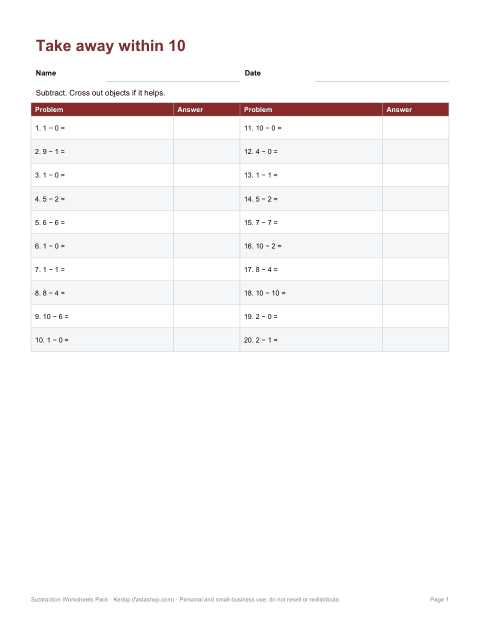
- Within 10 (PDF, DOCX)
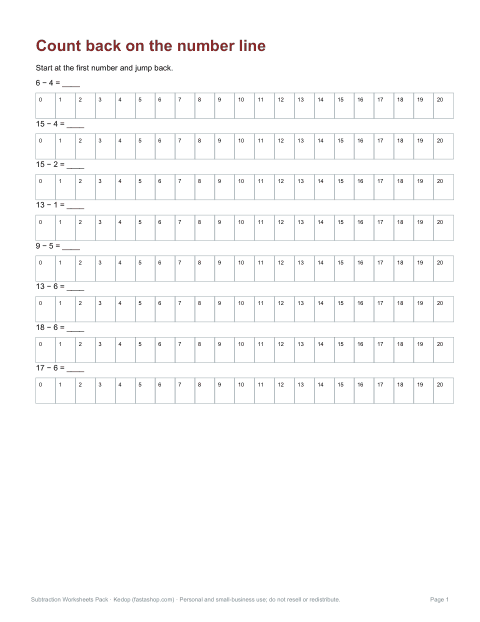
- Count back (PDF)
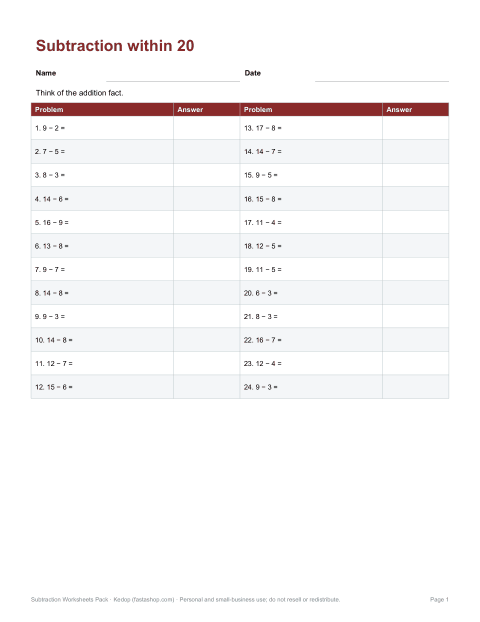
- Within 20 (PDF, DOCX)
- + 7 more
$5.00 USD, one-time 10 files · about $0.50 each
- Instant download
- 7-day refund
- Secure checkout by Stripe
7-day money-back guarantee. Full refund within 7 days of purchase, even after you download.
Free sample: Take Away Within 10 (PDF, 53 KB)
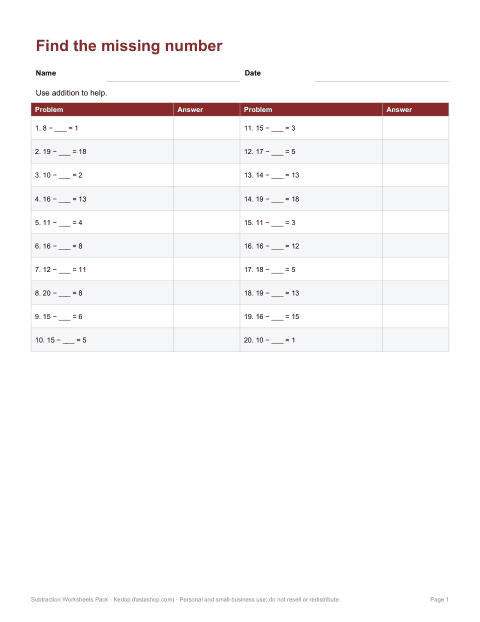
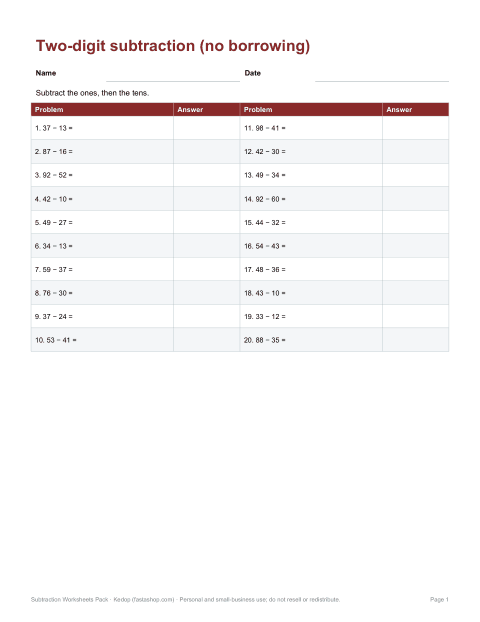
Subtraction Worksheets Pack
Printable subtraction worksheets with answer keys: take away within 10, counting back, within 20, fact families, missing numbers, two-digit with and without borrowing, three-digit and word problems, plus an Excel practice tracker.
- Within 10 (PDF, DOCX)
- Count back (PDF)
- Within 20 (PDF, DOCX)
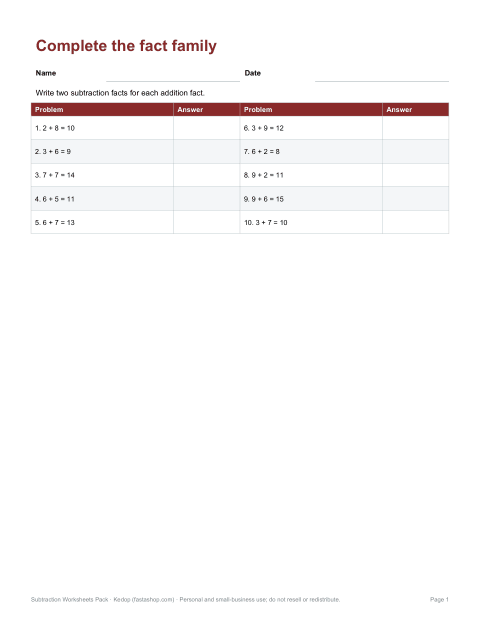
- Fact families (PDF, DOCX)
- Missing numbers (PDF, DOCX)
- 2-digit, no borrowing (PDF, DOCX)
- 2-digit, borrowing (PDF, DOCX)
- 3-digit (PDF, DOCX)
- Word problems (PDF, DOCX)
- Practice tracker (XLSX)
Formats: PDF, DOCX, XLSX. Instant download after payment (link valid 72 hours, up to 5 downloads). AI-assisted: the templates were drafted with AI help and reviewed and laid out before publishing.
$5.00 USD, one-time 10 files · about $0.50 each
- Instant download
- 7-day refund
- Secure checkout by Stripe
7-day money-back guarantee. Full refund within 7 days of purchase, even after you download.
Free sample: Take Away Within 10 (PDF, 53 KB)
Full refund within 7 days — see the refund policy and license.
Free printables
Single sheets you can print right now, no sign-up. The full pack adds every sheet in one download plus the editable files.
 Within 10 Subtraction Worksheets2 pages · free PDF
 Count Back Subtraction Worksheet1 page · free PDF
 Subtraction Within 20 Worksheet2 pages · free PDF
 Printable Fact Families Worksheets2 pages · free PDF
 Missing Number Subtraction Worksheets2 pages · free PDF
 2-Digit Subtraction Without Borrowing Worksheets2 pages · free PDF
 Printable 2-Digit Subtraction with Borrowing2 pages · free PDF
 Printable 3-Digit Subtraction Worksheets2 pages · free PDF
Worksheets included
| Sheet | Focus | Grade (typical) |
|---|---|---|
| Take away within 10 | 7 − 3 | K–1 |
| Count back on a number line | Jumps backwards | K–1 |
| Subtraction within 20 | 15 − 8 | 1 |
| Fact families | 3 + 5 = 8, 8 − 5 = 3 | 1–2 |
| Missing numbers | 12 − ? = 7 | 1–2 |
| Two-digit, no borrowing | 68 − 25 | 1–2 |
| Two-digit with borrowing | 52 − 27 | 2 |
| Three-digit subtraction | 634 − 258 | 2–3 |
| Word problems | How many are left? How many more? | 1–3 |
Three meanings of subtraction
- Take away: 9 birds, 4 fly away — how many are left? 9 − 4 = 5.
- Compare / difference: Sam has 9 stickers and Ava has 4 — how many more does Sam have? 5.
- Missing part: 9 children, 4 are girls — how many are boys? 5.
Children who meet all three meanings find word problems far easier, because they recognise subtraction even when nothing is “taken away”.
Borrowing (regrouping) step by step
- Write the numbers in columns: tens above tens, ones above ones.
- Start with the ones. In 52 − 27, 2 is smaller than 7, so borrow.
- Take one ten from the tens column: 5 tens become 4 tens.
- Add ten to the ones: 2 becomes 12.
- Subtract the ones: 12 − 7 = 5.
- Subtract the tens: 4 − 2 = 2.
- Answer: 25. Check by adding: 25 + 27 = 52.
Base-ten blocks make borrowing concrete: swap one rod (ten) for ten unit cubes before taking away.
Strategies for mental subtraction
- Count back for small numbers: 12 − 3 → 11, 10, 9.
- Count up when numbers are close: 53 − 48 → count up 2 to 50, then 3 → 5.
- Use addition facts: 14 − 6 = ? because 6 + 8 = 14.
- Subtract through ten: 13 − 5 = 13 − 3 − 2 = 8.
- Round and adjust: 62 − 19 = 62 − 20 + 1 = 43.
Common mistakes
- Subtracting the smaller digit from the larger in each column regardless of position (52 − 27 written as 35).
- Forgetting to reduce the tens after borrowing.
- Borrowing across a zero incorrectly in numbers like 403 − 158.
- Starting subtraction from the left.
Ask children to check every answer with addition — it catches most of these errors.
Using fact families
A fact family links one addition fact with its related facts: 3 + 5 = 8, 5 + 3 = 8, 8 − 3 = 5 and 8 − 5 = 3. Practising families shows that subtraction undoes addition and halves the number of facts children need to memorise.
Subtraction with zeros
Numbers with zeros, such as 400 − 158, trip up many learners. Because there are no tens to borrow from, borrow from the hundreds first: 4 hundreds become 3 hundreds and 10 tens; then borrow one of those tens: 9 tens remain and the ones become 10. Now subtract: 10 − 8 = 2, 9 − 5 = 4, 3 − 1 = 2, giving 242. Another approach is to subtract 1 from both numbers first — 399 − 157 — which removes the need to borrow and gives the same answer.
Practice routine
Short, frequent practice works best: five to ten minutes a day, mixing a few facts children know well with a few they are learning. Use the tracker to record accuracy rather than chasing speed too early.
Formats
Print-ready PDF worksheets with answer keys (US Letter; A4 with “Fit to page”) and an Excel practice tracker.
Frequently asked questions
What is borrowing in subtraction?
Taking one ten (or hundred) from the next column to make the digit being subtracted from large enough.
What grade learns subtraction with regrouping?
Usually second grade.
How do I check a subtraction answer?
Add the answer to the number you subtracted; you should get the starting number.
What is a fact family?
Three numbers related by addition and subtraction, such as 3, 5 and 8.
How do I subtract across zeros?
Borrow from the next non-zero place first, or subtract 1 from both numbers to avoid borrowing.
Are answer keys included?
Yes, for every worksheet.
Was AI used to create the worksheets?
Problems were generated by script and instructions drafted with AI assistance, then reviewed before publishing.